CAAPT: Computational Approaches for Addressing Problematic Terminology - Ontologies and Vocabulary
Release 2025-04-08
- Authors:
- Erin Canning✉
- Contributors:
- Victoria and Albert Museum
- Repository:
- Github repository
- CAAPT-O ontology:
- CAAPT-O namespace and documentation
- CAAPT-UC ontology:
- CAAPT-UC namespace and documentation
- CAAPT-DM ontology:
- CAAPT-DM namespace and documentation
- CAAPT-V vocabulary:
- CAAPT-V namespace and documentation
Abstract
The CAAPT Ontologies represent the structure and intellectual contents of terminology guideline documents along with the related work practices of reviewing and potentially editing records as a result of the identification of "problematic terminology" in cultural heritage institutions, with a particular focus on the museum context. It is named for the research project in which it was developed: the AHRC-funded studentship Computational Approaches for Addressing Problematic Terminology in V&A Museum catalogues. The three ontologies for this project - CAAPT-O, CAAPT-UC, and CAAPT-DM - model terms, definitions, suggestions, and actions, drawing on existing ontologies such as CIDOC CRM, OntoLex, CULCO, and the Web Annotation Data Model to represent the key concepts involved in critical cataloguing as defined by domain experts. The vocabulary - CAAPT-V - includes vocabulary concepts for classifying terms, texts, suggestions, senses, and catalogue record field types.Introduction
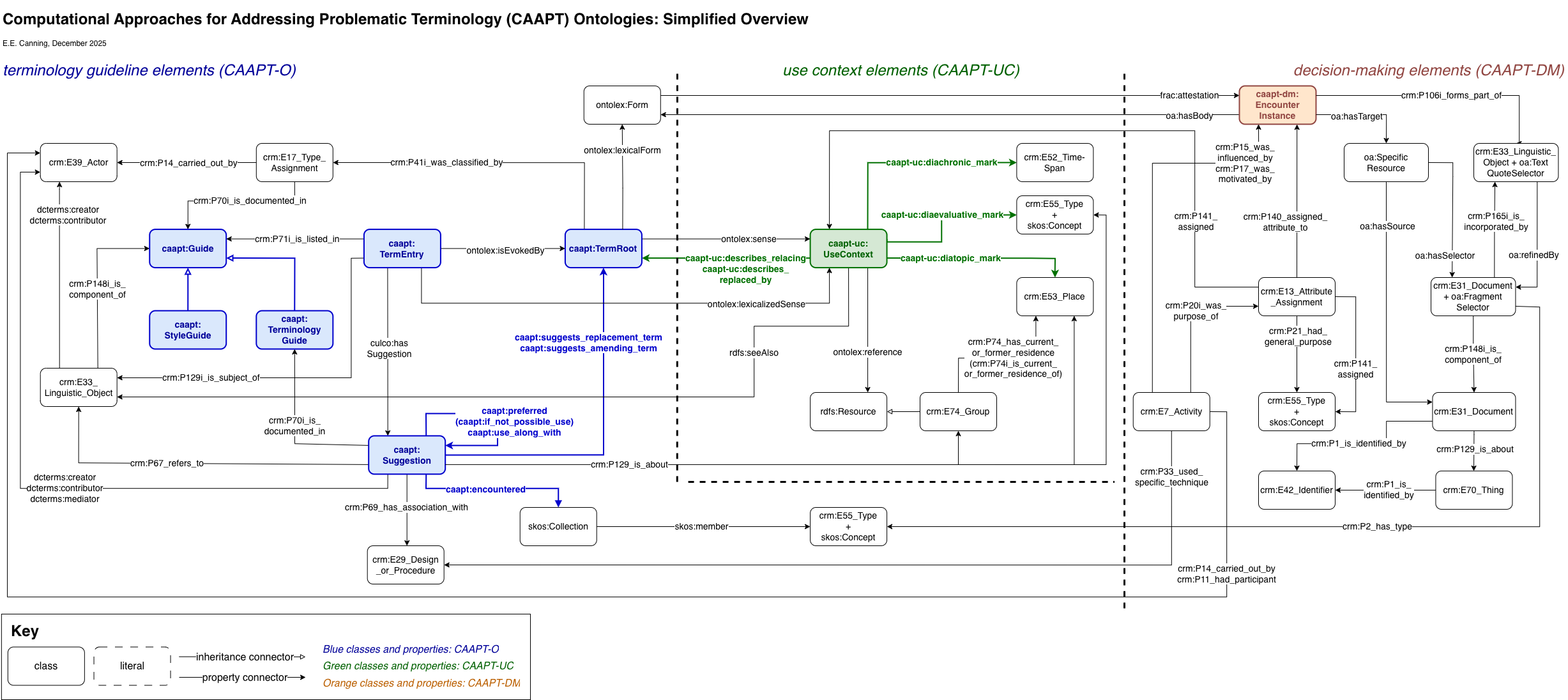
The CAAPT ontologies model the domain of critical cataloguing in museums, focusing on cataloguing revision work. The ontological framework is made up of three seperate but interrelated models and one set of vocabularies:
- CAAPT-O: the ontology for the representation of museum terminology guidance documents, including terms, definitions, and suggestions for use.
- CAAPT-UC: the ontology for the representation of details of the contextual use of terms as described in museum terminology guidance documents.
- CAAPT-DM: the ontology for the representation of museum-based critical cataloguing decision-making.
- CAAPT-V: a set of vocabularies for the implementation of a knowledge graph structured according to the CAAPT ontologies.
Background information and early work on this project can be found in Canning (2024). Defining an Ontology for Museum Critical Cataloguing Terminology Guidelines, Proceedings of the 9th Workshop on Linked Data in Linguistics @ LREC-COLING 2024.
This work is being carried out as a part of the AHRC-funded studentship Computational Approaches for Addressing Problematic Terminology in V&A Museum catalogues.
Ontologies
Vocabulary
CAAPT Ontologies
CAAPT-O
CAAPT-O is an ontology for the representation of museum terminology guidance documents.
The CAAPT-O namespace and documentation can be found at: https://w3id.org/caapt/ontology.CAAPT-UC
CAAPT-UC is an ontology for the representation of details of the contextual use of terms as described in museum terminology guidance documents.
The CAAPT-UC namespace and documentation can be found at: https://w3id.org/caapt/use-contexts.
CAAPT-DM
CAAPT-DM is an ontology for the representation of museum-based critical cataloguing decision-making.
The CAAPT-DM namespace and documentation can be found at: https://w3id.org/caapt/decision-making.
CAAPT Vocabulary
CAAPT-V
CAAPT-V is a set of vocabularies for the implementation of a knowledge graph structured according to the CAAPT ontologies .
The CAAPT-V namespace and documentation can be found at: https://w3id.org/caapt/vocabulary.
Acknowledgments
This research is taking place as part of the AHRC-funded Collaborative Doctoral Partnership scheme grant AH/X004775/1.